Introduction
Divorce legal costs in Connecticut vary significantly depending on whether the case is uncontested or contested, how marital property is divided, and whether child-related issues are involved. Connecticut divorces are handled in Superior Court, and costs tend to be higher in urban and suburban judicial districts where complex financial cases and custody disputes are more common. Financial exposure in litigation is rarely contained to the courtroom, which is why mapping the broader framework of family law expenses in Connecticut helps anticipate outside consequences.
Connecticut is consistently ranked among the states with the highest attorney hourly rates, which means divorce expenses can escalate quickly when disagreements require court hearings, discovery, or trial. Even no-fault divorces can become expensive if negotiations break down. This guide explains average divorce legal costs in Connecticut, including lawyer fees, court costs, and the factors that most influence total expense.
Divorce Lawyer Fees in Connecticut
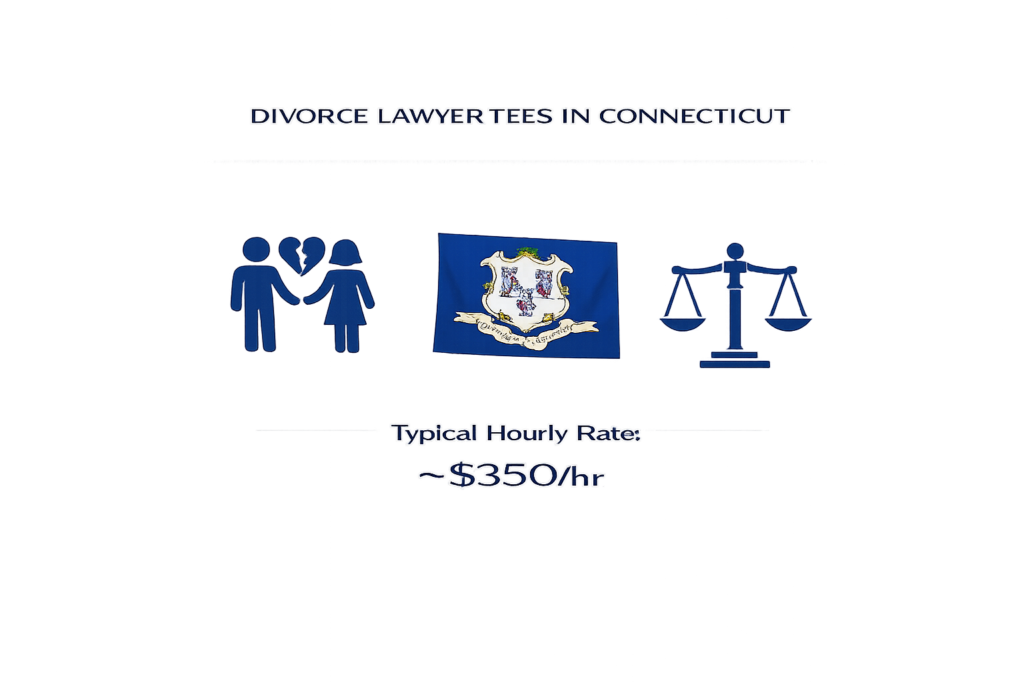
Divorce attorneys in Connecticut typically bill hourly, though some uncontested matters may be offered at a flat fee.
Typical Legal Fee Ranges
| Divorce scenario | Estimated legal fees |
|---|---|
| Hourly attorney rates | $325–$600 per hour |
| Uncontested divorce | $2,000–$5,000 |
| Contested divorce | $10,000–$40,000+ |
| High-asset or custody disputes | $20,000–$75,000+ |
Hourly billing means costs rise with negotiations, filings, discovery, and court appearances.
For national benchmarks, see How Much Do Lawyers Cost in the United States.
Connecticut Divorce Court Costs and Administrative Fees
Attorney fees do not include mandatory court and procedural costs required to process a divorce.
Common Divorce-Related Costs
| Cost category | Cost impact |
|---|---|
| Divorce filing fees | Fixed |
| Service of process | Low |
| Motions and court hearings | Medium |
| Mediation or parenting education | Medium–High |
Mediation and repeated hearings are frequent cost drivers in custody-related cases.
Additional procedural context is covered in Court Costs in the United States.
Factors That Increase Divorce Costs in Connecticut
Divorce expenses rise as legal and financial complexity increases.
| Cost driver | Impact on total cost |
|---|---|
| Disputed child custody or support | High |
| Division of real estate, investments, or businesses | High |
| One spouse contests the divorce | Medium–High |
| Multiple court hearings | Medium |
| Trial proceedings | Very high |
⚠️ Trials and financial discovery are the most expensive phases of Connecticut divorce cases.
Uncontested vs. Contested Divorce Costs in Connecticut
| Divorce type | Typical total cost | Timeline |
|---|---|---|
| Uncontested divorce | $2,000–$5,000 | Shorter |
| Contested divorce | $15,000–$50,000+ | Extended |
Uncontested cases often resolve through agreement or mediation, while contested cases can last many months or longer.
How Connecticut Divorce Costs Compare to Other States
Divorce legal costs in Connecticut are generally:
- Among the highest in the United States
- Higher than most Midwest and Southern states
- Comparable to New York and Massachusetts for complex cases
A broader comparison is available in Legal Costs by State.
How to Reduce Divorce Legal Costs in Connecticut
Divorce stress does not stop at pleadings; it spills into payroll departments, lending relationships, and professional reputations. When income withholding orders or financial disclosures reach employers and banks, the case acquires external gravity. Reviewing the expense profile tied to child-related financial disputes in Connecticut courts becomes critical because those orders often activate third-party compliance. Likewise, assessing the cost realities surrounding spousal maintenance proceedings in this state prepares parties for how extended litigation may intersect with credit lines, asset freezes, or institutional scrutiny beyond the family docket.
Strategic planning can significantly reduce divorce-related expenses.
| Strategy | Cost impact |
|---|---|
| Reaching agreement early | Major savings |
| Using mediation instead of litigation | Major savings |
| Organizing financial documents | Moderate savings |
| Limiting court motions | Major savings |
| Avoiding trial when possible | Major savings |
💡 Reduced conflict almost always results in lower attorney fees.
FAQ — Divorce Legal Costs in Connecticut
How much does a divorce lawyer cost in Connecticut?
Hourly rates typically range from $325 to $600, with total costs depending on case complexity.
Are uncontested divorces expensive in Connecticut?
Not usually. Many uncontested cases resolve for $2,000–$5,000.
Why are contested divorces so costly?
Discovery, hearings, custody disputes, and trial preparation drive up hourly fees.
Do court costs include mediation and parenting classes?
Often no. These services are typically billed separately.
Can divorce costs increase after filing?
Yes. New disputes, motions, or trial preparation can raise costs substantially.
What is the biggest financial mistake in divorce cases?
Litigating minor issues instead of negotiating early.
Can attorney fees be recovered after divorce?
Sometimes. Courts may order fee-sharing based on financial disparity, but it is not guaranteed.
Related Guides
Lawyer Fees in the United States
Legal Costs in Connecticut
Family Law Legal Costs in Connecticut
Child Custody Legal Costs in Connecticut
Child Support Legal Costs in Connecticut
Alimony Legal Costs in Connecticut
Adoption Legal Costs in Connecticut
External Resources (Official & Authoritative)
Connecticut Bar Association — Family Law Resources
Connecticut Judicial Branch — Divorce & Family Case Procedures
Conclusion
Divorce legal costs in Connecticut typically range from $2,000 for uncontested cases to more than $50,000 for highly contested or high-asset divorces. Attorney fees, court involvement, financial complexity, and custody disputes are the primary cost drivers.
Understanding how these expenses arise allows couples to plan realistically, reduce risk, and make informed decisions when navigating divorce in Connecticut.